Affichage des articles dont le libellé est Italy. Afficher tous les articles

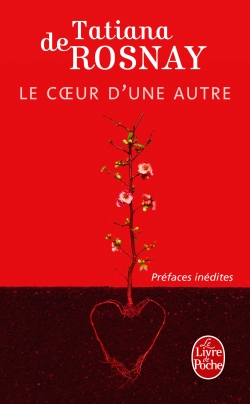
[FR] Le cœur d'une autre - Tatiana de Rosnay

1 commentaire:

Titre : Le cœur d'une autre
Auteur : Tatiana de Rosnay
Éditeur : Le Livre de Poche
Date de publication : 2009 aux Éditions Héloïse d'Ormesson
Pages : 281
 

* Le professeur m'a appris un jour qu'un receveur voue une reconnaissance éternelle à son donneur. Mais je ressens bien plus qu'une simple reconnaissance envers Constance. Je lui dois la vie, et le goût de la vie. Commen lui dire merci, puisqu'elle n'est plus sur terre ? *
_________________________________ 

Bruce, un quadragénaire divorcé un peu ours, un rien mysogyne, est sauvé in extremis par une greffe cardiaque. Après l'opération, sa personnalité, son comportement, ses goûts changent de façon surprenante. Il ignore encore que son nouveau cœur est celui d'une femme.
Mais quand ce cœur s'emballe avec frénésie devant les tableaux d'un maître de la Renaissance italienne, Bruce veut comprendre. Qui était son donneur ? Quelle avait été sa vie ? Des palais austères de Toscane aux sommets laiteux des Grisons, Bruce mène l'enquête. Lorsqu'il découvrira la vérité, il ne sera plus jamais le même. 


Mélangeant génétique et fiction, Tatiana de Rosnay nous entraîne sur les pas de Bruce Boutard après que, suite à une malade cardiaque, il ait reçu un nouveau cœur. Sa vie change alors du tout au tout et, persuadé que cela a un lien avec son donneur, il part sur les traces de cette inconnue qui lui réserve bien des surprises.
Comme toujours, la plume magnifique et fluide de Tatiana de Rosnay m’a entraînée dès les premières pages. Peu à peu, nous apprenons à connaître Bruce, un homme plutôt désagréable, inintéressant et toute à fait ordinaire. Une image un peu stéréotypée qui contraste fortement avec celui qu’il deviendra après sa transplantation. Les changements s’opèrent petit à petit, surprenant tout d’abord le lecteur avant d’interpeller le personnage lui-même.
Commence alors une enquête des plus intéressantes sur son donneur ou plutôt, sa donneuse. Quel choc pour cet homme fier et quelque peu phallocrate que d’apprendre que son cœur a appartenu à une femme. Pourtant, plus sa personnalité et ses goûts se révèlent différents, plus il a envie de découvrir celle qui lui a sauvé la vie. Entre l’Italie, la Suisse et la France ; entre l’art et l’amour, Bruce part sur les traces de cette femme mystérieuse dont il ne sait rien encore.
S’alternent alors les moments de suspense, les scènes romantiques et les instants touchants, alors que Bruce rencontre des personnages hauts en couleur, tous plus intéressants les uns que les autres : la jolie Joséphine, le mystérieux comte Valombra, son fils Mathieur, l’accueillant couple Weatherby, la taciturne baronne Landifer... et, bien sûr, indirectement, Constance, sa donneuse. Au premier abord, on peut avoir l’impression qu’un nombre de personnages aussi élevé pour un roman somme toute assez court est quelque peu exagéré ; ce n’est toutefois pas le cas. Chacun a sa propre personnalité, son importance, et apporte quelque chose au déroulement de l’histoire. De plus, ils sont introduits de manière si naturelle qu’on ne remarque même pas à quel point on s’attache à eux.
J’ai eu l’impression que Le cœur d’une autre était, en fait, plus l’histoire de Constance que celle de Bruce ; que si nous devions choisir le vrai héros, ce serait elle plutôt que lui. La part de mystère qui entoure cette jeune fille disparue m’a convaincue. Nous la découvrons peu à peu, au travers de Bruce, mais il y a toujours une part d’elle qui restera inconnue et inaccessible, tant pour les lecteurs que pour les autres personnages. Bruce, quand à lui, a rapidement changé de statut à mes yeux. Homme désagréable, il devient bien vite touchant et attachant. En raison de sa maladie ou de son nouveau cœur ? Au lecteur de décider.
Le mélange de considérations sur la médecine et de fiction m’a immédiatement séduite. Comme l’explique Joël de Rosnay, père de l’auteur et biologiste reconnu, dans sa préface, l’approche n’est aujourd’hui pas confirmée par la science. Et, pourtant, il est extrêmement facile d’y croire, de se laisser entraîner par le cœur du héros sur les traces de Constance. Pour cette raison, on peut lire le livre comme une simple fiction, mais l’histoire suscite également des questionnements très intéressants pour qui s’y arrête un instant.
En résumé, un véritable coup de cœur pour une histoire de cœur extraordinaire ! Une alliance de romance et de mystère, avec un peu de science en filigrane qui suscitera chez le lecteur toute une série d’émotion... et la fin vous fera peut-être bien verser une petite larme. À lire absolument.


[EN] Through a glass, darkly - Donna Leon

Aucun commentaire:

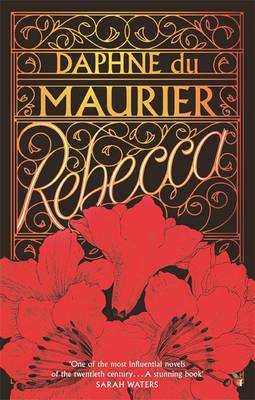
Title: Through a glass, darkly
Series: Brunetti series #15
Author: Donna Leon
Publisher: Arrow Books
Release date: 2006
Pages: 340
 

* As they watched, he blew into one end of the iron 'canna', inflating the blob of glass at the other end. Quickly, with the grace of a baton twirler, he swung the glowing mass until it was just above the bucket and squeezed it carefully into the cylindrical tub, moving it up and down and slipping it around until it slid inside. He blew repeatedly into the end of the pipe, each puff forcing a halo of sparks to fly from the top of the tub. When he pulled the 'canna' out, the blob was a perfect cylinder, now recognizable as the flat-bottomed vase it would become.*
_________________________________ 

It is a luminous spring day in Venice, as Commissario Brunetti and Inspector Vianello take a break from the Questura to come to the rescue of Vianello's friend Marco Ribetti, who has been arrested while protesting against chemical pollution of the Venetian lagoon.
But it is not Marco who has uncovered the guilty secret of the polluting glass foundries of the island of Murano, nor he whose body is found dead in font of the furnaces which burn at 1,400 degrees, night and day. The victim has left clues in a copy of Dante and Brunetti must descend into an inferno to discover who is fouling the waters of the lagoon...


Through a glass, darkly, is not a religious book, despite the obvious reference to the biblical quotation. It can probably be understood as in Shakespeare’s Tempest, where it is used to explain that we do not necessarily understand something at once, but that we will in the end. Or as a simple allusion to the island of Murano and its famous glass industry. This play upon words demonstrates once more Donna Leon’s talent for telling stories.
On a lovely day of early spring, Commissario Brunetti helps one of his assistant Vianello’s friend who has been arrested during an environmental protest organised in order to protect the lagoon from chemical pollution. Vianello’s friend is the son-in-law of De Cal, a glass factory owner who has been threatening him violently in the bars of Murano. Brunetti’s curiosity is aroused and he begins an unofficial investigation on that violent man who is disliked among so many other factory owners. However, what looked like unimportant events soon turns out to be significant: a man is found dead on Murano in front of a furnace… precisely in De Cal’s factory. As Brunetti is left to investigate with an old copy of Dante’s Inferno and coded notes left by the victim, we discover a rather dark side of Venice: pollution, politics and family tragedies.
The plot itself is well constructed and causes surprise, especially towards the end. At the beginning, there are several different stories which give a good introduction to the main themes of the books, although the reader has to wait for quite a long time until the actual mystery begins. From the Questura to Brunetti’s home, the story unfolds slowly, revealing many twists and turns. As it develops, we are once more amazed to discover how everything is connected in order to make a realistic and exciting plot.
The description of the Venetian life also adds to the depth of the book. An important part of this local colour is the Italian names that can be found all the way through the book. The places are described accurately and so is the food, which shows us how important it is in Italian culture. With the Commissario, we are led through the streets of that wonderful city and on the island of Murano, where we discover the world of glass making.
Donna Leon also focuses on major current issues of Venice: pollution of the lagoon by factories, Italian bureaucracy, politics… If you are interested in Italian culture and like mystery, as well as well constructed and organised plots, and very human characters, have a try. Be careful though, as there are more than twenty mysteries featuring Brunetti and you may well end up becoming addicted to them.
_________________________________

Thank you Mum for lending me the book


http://iletaitun-livre.blogspot.ch/2013/08/challenge-travelling-world-in-books.html


[EN] Surviving with wolves - Misha Defonseca

Aucun commentaire:

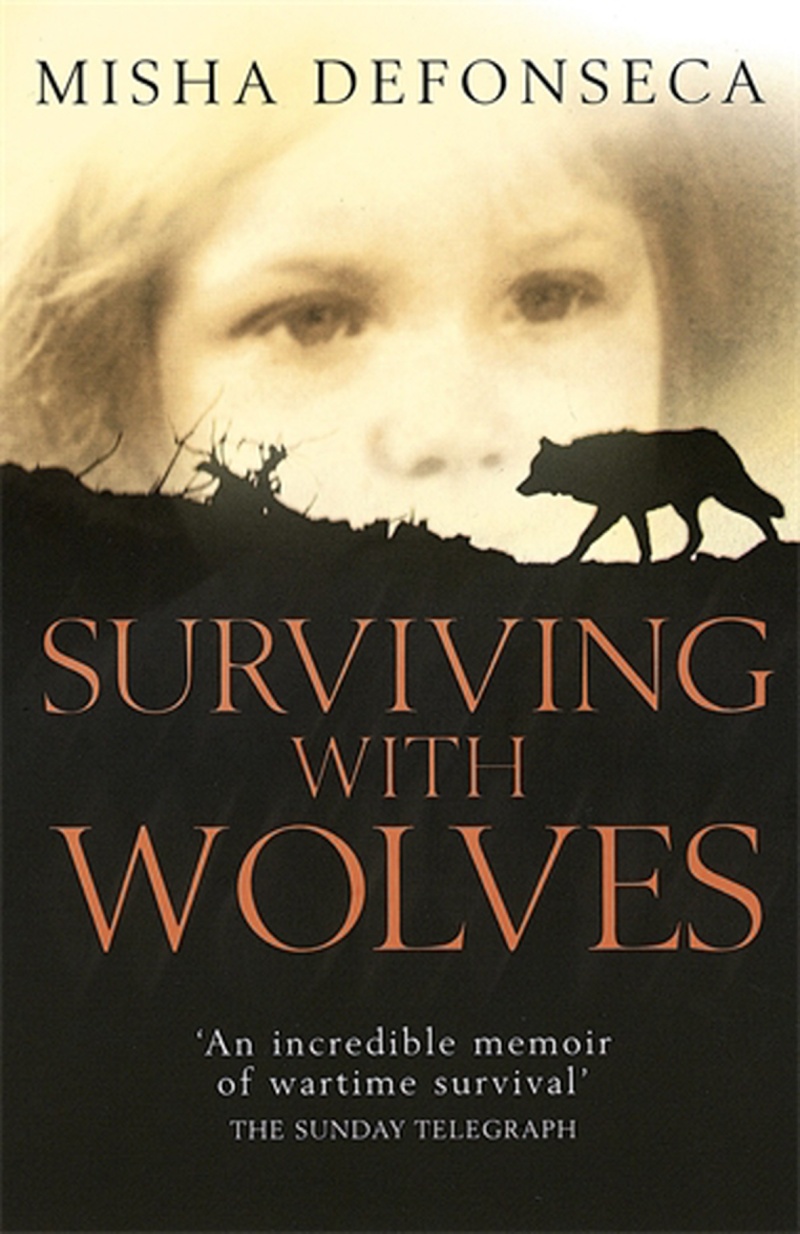
Title: Surviving with Wolves
Original Title: Survivre avec les loups (French)
Translator: Sue Rose
Author: Anita Shreve
Publisher: Piaktus books
Release date: 1997 (English transalation: 2005)
Pages: 231
 

* You keep going first to find something to eat and then because you always believe that, beyond that tree or over that high slope, you'll find a village, or people or a road sign pointing you in the right direction.*
_________________________________ 

Misha was only seven when the Nazis took her Jewish parents away from her in Brussels. No one told her why her parents were no longer with her; only that they had gone East. So one day, equipped with just a tiny compass, the little firl set out East to find them. Alone and on foot, Misha crossed Belgium, Germany, Poland and the Ukraine.
Surviving with wolves is Misha's extraordinary and poignant story - of how a young girl witnessed the appalling cruelties of war, and for whom the animals of the forest proved safer than humans. It is a book that will never be forgotten by anyone who reads it.


“At one lecture, a woman said to me, ‘You’re not a holocaust survivor. You didn’t live in the camps.’ Hers was just one voice among others. It shouldn’t have upset me as it did, but I was annoyed with myself for telling the world a story that wasn’t universally accepted, just because it wasn’t like everyone else’s. I was different, as always… ” Surviving with wolves is indeed unique, a story different from any other one you might have read. It takes place during the war and the reader sees through Jewish eyes. Until then, you will tell me that there is nothing unusual about it, and you are right. What makes this book so extraordinary how its story actually unfolds and how the different events that occur are told.
Misha lives in Brussels with her parents and even though they are rather poor, she is happy. But she is Jewish and her life changes forever when her parents are taken away by Nazis. Misha is saved and placed in a Belgian family who will take care of her. As she is only seven, she does not fully understand what is happening. She knows that she must not say that she is Jewish; she knows that the Nazis are dangerous; she knows that her parents are in the East. Nobody explained anything else to her. So one day, she sets off towards the East to find them and starts an unimaginable journey through Europe in war.
The story of the journey itself is wonderful. We follow the little girl who knows nothing about war in her adventure. She is innocent but clever and very brave. From the very beginning, we see how she can survive in hostile environment, with people fighting around her and the whole world collapsing. Because of this traumatic period, nobody tries to stop her; it is not usual to see poor and filthy children on their own, and Misha does not trust people. She steals food from the farms or eats from carcasses rather than begging or asking for help. She sleeps in the forest rather that hideing in deserted buildings. This is how, on her long way trough Belgium, Germany, Poland, Russia and the Ukraine, she meets wolves with whom she develops a wonderful relationship.
This relationship is incredible at first, but yet as the story goes on we understand it better. The descriptions of the majestic animals are poignant and we clearly see why the little girl trusts them rather than humans: they don’t have guns, they are not deliberately cruel to one another, they have clear rules and they can be trusted… Unlike human beings or at least unlike the human beings Misha has met.
The scenes with nature are cleverly mixed with war scenes. As Misha does not trust humans, she does not seek social contact but inevitably she will see some of the horrors of the war. An interesting aspect is that, by travelling, we see how different people react to the war. The reader is given an insight into Polish guerrillas’ fights, Jews’ persecution, German soldiers’ methods, Russian civilians’ hope and prisoner camps…
These are described with accurate details of what the little girl felt when she actually lived the scene and mixed with explanations given by Misha years later, when she writes about her adventure. Telling this story with two perspectives was a sensible choice: we understand the little girl experience, her innocence and how traumatic everything was for someone who did not understand at all the gravity of what was happening; at the same time, we have more factual explanation to help us understand how Misha’s personal story is linked to the rest of the events.
One of the main controversies that arose with the publication of this book regarded the truth of the story. Even if Misha first presented it as real, it turned out that she had actually made it up: she was not Jewish and she did not travel all the way through Europe, living with wolves, to find her parents. This revelation should however not lessen the beauty of the story. Misha has survived the war and her need to tell a story that differs from the one she actually lived shows how she tries to heal from this traumatic experience.
Surviving with wolves is therefore a book that is worth reading, especially for people who like animals and are interested in war stories. However, anybody can find it interesting, as it is extremely varied and well written..

 
Surviving with wolves has been adapted into a film. 

http://iletaitun-livre.blogspot.ch/2013/08/challenge-travelling-world-in-books.html


Adrian McKinty (1) Alexander Key (1) Alexander Maksik (1) Alexis Hayden (1) Amanda Kyle Williams (1) Ambre Dubois (2) Amélie Nothomb (1) Ange Godart (1) Angélique Ferreira (1) Anita Shreve (1) Ann Patchett (1) Annabelle Valenzuela-Alarcon (1) Arnaldur Indridason (1) Aurélien Molas (1) Bernard Lenteric (1) Carol Higgins Clark (1) Chloé Bourdon (1) Christian Bindner (1) Céline Gierts (1) Dan Brown (1) Dan Millman (1) Danielle Steel (1) Delphine de Vigan (1) Domnica Radulescu (1) Donna Leon (1) Emily Brontë (1) Emylia Hall (1) Erik Larson (1) Franck Thilliez (1) Fred Vargas (2) Gerbrand Bakker (1) Hallgrímur Helgason (1) Henning Mankell (2) Henri Beaudout (1) Henri Lœvenbruck (1) Ian McEwan (1) Inti Salas Rossenbach (1) J.K. Rowling (2) Jack Thorne (1) Jacques Côté (1) Jean-Charles Hue (2) Jenny Sigot Müller (1) Jo Nesbø (1) Jodi Picoult (1) John Brandon (1) John Tiffany (1) John Wyndham (1) José-René Mora (1) Joël Vernet (1) Julia Bell (1) Julien Blanc-Gras (1) Jussi Adler-Olsen (1) Kari Kinard Pratt (1) Kate Atkinson (1) Kent Johnson Olsen (1) L.F. Falconer (1) Laura Gardner (1) Laura Kasischke (1) Lawrence W. Gold (1) Lewis Carroll (2) Lionel Camy (1) M.L. Stedman (1) Malcolm MacKay (1) Marian Izaguirre (1) Marie Laberge (1) Marina Lewycka (1) Markus Zusak (1) Mary Higgins Clark (1) Mary Hoffman (6) Mathieu Dombre (1) Matthias Rouage (1) Michael Morpurgo (3) Michel Bussi (2) Mikkel Birkegaard (1) Misha Defonseca (1) Monica Kristensen (1) Natacha Catel (1) Pablo Mehler (1) Penny Hancock (1) Peter May (1) Philippe H. Besancenet (1) Pierre Thiry (1) Rachid Santaki (1) Rawia Arroum (1) Raymonde Malengreau (1) Rhonda Byrne (1) Riikka Pulkkinen (1) Robert Galbraith (J.K. Rowling) (3) Rodrigo Rey Rosa (1) Rosamund Lupton (1) Ruta Sepetys (1) Ruth Rendell (1) Sandrine Collette (2) Sarah Latham (illustrator) (1) Sarah Singleton (2) Sheri Speede (1) Sofi Oksanen (1) Stef Penney (1) Susanne Mischke (1) Tatiana de Rosnay (5) Victoria Hislop (1) Viveca Sten (1) William Morris (1) Yasmina Khadra (1) Éric-Emmanuel Schmitt (1)

 
Design by Laraemilie